How To Clean Upholstery
Tips And Instructions
Learning how to clean upholstery can be important in any home that you want to stay looking clean, beautiful and well cared for.
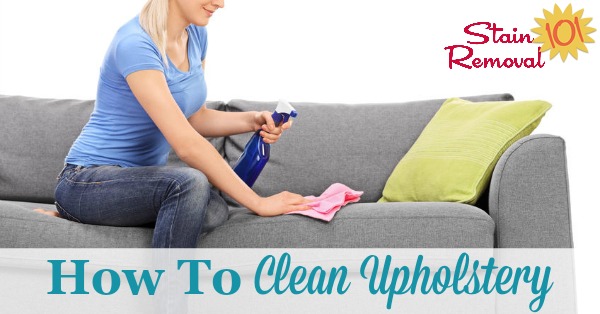

This is because no matter how carefully you take care of your upholstered furniture accidents do happen.

A spill can happen quickly, and when it does time is of the essence. Plus, even if you are fortunate enough not to actually spill something, general dirt and dust can accumulate as part of normal use.
Therefore, below I explore upholstery cleaning tips, homemade and commercial upholstery cleaners, and even give you a chance to give your own tips for cleaning upholstery.
I am focused on this article mainly on fabric upholstery. Leather or suede upholstery has different cleaning and care requirements.
Before Cleaning Your Upholstery Make Sure To Vacuum It
If your upholstery starts to look dingy, or has developed lots of stains and spots, before you do anything else it is important to vacuum it. This will remove the dirt and dust which, when wet, can further dirty your couch if it is not removed first. Use an upholstery attachment to get in all the cracks and crevices, and to thoroughly clean all the cushions.
Depending on how much you use various upholstered furniture, you may need to vacuum frequently, but at the least I suggest vacuuming all upholstered furniture monthly. (You can find out more monthly cleaning tasks here.)
(You can get more tips for reducing and removing dust in your home here.)
In addition, remove as much pet hair as possible. If a vacuum itself does not seem to get it all, try a pet hair remover. You can read reviews of pet hair removers here to find which ones work well on upholstery.
The Most Important Tip For How To Clean Upholstery: Blot The Spill Quickly
If you don't just have general dirt, or old stains, but instead a fresh spill, you don't want that spill to soak into the furniture stuffing, into the wood, or to set into the upholstery fabric.
Therefore, the first thing to do when any spill occurs is to blot (not scrub or rub) the spill up with a white cloth as quickly as possible to lessen the spread of the stain, and to keep it from setting in a larger area.
Blotting is perhaps the most crucial, and also common sense part of how to clean upholstery.
How To Know What Upholstery Cleaners Should Be Used To Clean Your Upholstery
Next, you need to know what types of upholstery cleaner should be used on your upholstery.
This is dependent on two things: (1) the type of fabric the upholstery is made of; and (2) the type of spill or stain on the upholstery.
Each will be addressed in turn.
Upholstery fabrics can be mystery sometimes, because the fabrics used for upholstery can be varied, such as cotton, wool, silk, acetate, linen, rayon, olefin, and acrylic just to name a few, including blends of these fabrics.
In addition, different upholstery fabrics have been dyed with different colors, in different ways, and the age of the upholstery should also be taken into account.
Note, if this is very old upholstery, or antique or very valuable, I would suggest calling in a professional.
If you don't know what upholstery cleaner can be used on your upholstery the first step is to look at the tag. You haven't removed the tag have you?
If you have removed it, read on for future reference so you can know why you actually want to save those tags, and I'll explain what you should do when you don't have a tag further down.
How To Clean Upholstery: Understanding Upholstery Cleaning Codes
The furniture industry has created a code for its care tags so you can quickly know how to clean upholstery when a spill occurs.
These tags are typically found hanging in an inconspicuous place on the side of the furniture, or under seat cushions.
Here is what the codes mean:
W: Clean the upholstery fabric with a water based detergent.
S: Clean the upholstery fabric with a water free product, such as dry cleaning solvent.
WS: You may clean the upholstery fabric with either a water based cleaner or a water free cleaner, depending on the type of stain. (This is the best type of upholstered furniture to purchase if you plan to remove your own stains.)
X: This upholstery fabric must be professionally cleaned. You should only vacuum and brush it -- never use any type of upholstery cleaner on it yourself. (Unless you are extraordinarily rich, you really want to steer clear of buying furniture with this on the tag in the future.)
What To Do If You Don't Have The Upholstery Tags Anymore
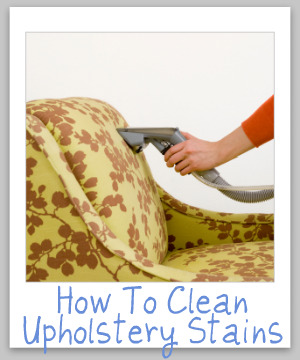
With all cleaning methods I would suggest that you test your upholstery stain remover first in an inconspicuous area, to check to make sure the stain removal method will not harm it and for color fastness.
This would be an even more important step when you don't have a upholstery tag to rely upon anymore.
You also do all stain removal on upholstery at your own risk, especially when you don't have the codes.
If you are unsure, or want to be especially cautious, I would call a professional for advice or assistance on how to clean upholstery without tags still attached or accessible.
I also suggest when you don't know the codes or the stain, start with the most conservative cleaning method and proceed cautiously from there.
The Type Of Stain Or Spill Also Impacts What Cleaning Method And Cleaner You Use
There is no one size fits all upholstery cleaner that will work on all types of stains, such as food and drinks, protein, oil and grease, and other stains.
Here are some suggestions for upholstery stain removal, which gives general guidance on what type of cleaner to use on various types of stains.
In addition, here are tips for removing upholstery spots.
Another good resource for how to clean upholstery stains is the A-Z Stain Removal Guide which lists many common types of stains, and gives instructions for cleaning specific types of stains from upholstery.
Both of these instructions assume your upholstery has a code of WS.
If it does not, and the cleaning method suggested conflicts with your tag you will need to call a professional to help clean your upholstery, or try these upholstery dry cleaning tips, which explain how to spot clean dry clean only upholstery.
Upholstery Cleaners For Your Furniture
Once you know what type of upholstery cleaners you can use on your upholstered furniture, the next step in how to clean upholstery is that you need to choose if you will use commercial cleaners or a homemade cleaner.
If you want to purchase one you can submit a review of an upholstery cleaner here, or read one already submitted by others. Please note that to dry clean your upholstery you will have to purchase a product, since all the homemade varieties listed below assume you can use a water-based cleaner.
If you want to make your own cleaner, for either environmental or money saving reasons, you can also check out these homemade upholstery cleaner recipes if you need a water-based cleaner. Further, you can also share your own recipes and home remedies for upholstery cleaner here.
Do You Have Any Upholstery Cleaning Tips Of Your Own To Share?
If you have your own tip to share about upholstery stain removal and cleaning, you can submit your upholstery cleaning tips here, or read other tips which have already been submitted.
Thanks For Visiting My Website: Grab Your Free Gift!

Hi, I'm Taylor, a busy mom with 3 kids, so I have lots of hands on experience with house cleaning, laundry and my fair share of spots, spills and other messy catastrophes. Thanks for visiting my site.
I update the website all the time with tips, tutorials, cleaning recipes, reviews of products from readers like you, and tests I've done on various cleaners, removers and laundry supplies.
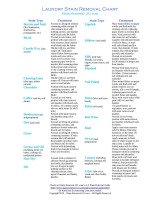
I'd love to give you a gift! When you subscribe to my free weekly newsletter you will receive a free printable laundry stain removal chart that you can reference as needed.
I hope you enjoy this gift, and stop by again soon!
Related Pages You May Enjoy
Cleaning Products Reviews: Which Supplies Work Best?
Go From How To Clean Upholstery To Home Page
CAUTION: This website is provided for informational purposes only. It is provided as is, without warranties or guarantees. Some stains and messes just won't come out, and are permanent. Further, some cleaning methods can harm your item, so if what you want to clean or launder is sentimental or expensive call a professional. See disclaimer of liability for more information.
Let's Stay Connected!


Get Free Email Updates
(and get a FREE printable)
Related Pages
 Tell Me Your Carpet Stain Remover Reviews
 Tell Me Your Carpet Stain Removal Tips
 Lots Of Homemade Carpet Cleaning Solution Recipes

 Visit Household Management 101
 Visit Home Storage Solutions 101
Share Your Comments, Tips & Ideas